“480000 yuan” search results (4240)


An introduction to the estates of Ethiopian coffee-producing areas with the natural conditions for growing coffee
Sustainable coffee culture Ethiopian coffee beans grow in close to the natural environment, after years of planting under the same growth conditions, Ethiopian coffee beans have gradually adapted to the environment here. More than 60% of coffee beans are grown in forests or semi-forests. The villages that grow coffee in large areas account for about the total amount of coffee produced in the country.
2016-07-06 With planting coffee natural conditions Ethiopia producing areas manors introduction
Ethiopian Coffee Flavor Description Grind Characteristics Variety Producing Area Taste Boutique Coffee Introduction
Ethiopian coffee grade: Ethiopian washed coffee Yirgacheffe G1 G2 Sidamo (Yirgacheffe, Sidamo) the highest grade is second and third grade (G2, G3), the eastern part of Ethiopia sun processing coffee is mostly fourth or fifth grade (G4, G5). In many cases, fourth-grade coffee is labeled as five-grade in order to reduce taxes. The current classification is not very uniform, there are
2016-10-12 Ethiopia Coffee Flavor Description Grind Characteristics Variety Region Taste
Unique Panamanian Coffee Flavor and Taste the characteristics of Cochell Manor are introduced.
Located in the most advantaged natural conditions, Ethiopia produces unique high-quality coffee every year. Ethiopia's coffee growing cycle brings the joy of harvest to the country every year. Beautiful white coffee flowers will bloom and bear fruit every year from March to April. Only the reddest and ripe fruits will be selected between September and December.
2016-08-08 Quality unique Panama coffee flavor taste manor producing area characteristics introduction
Introduction to the flavor and taste characteristics of Ethiopian coffee manor with fragrant and mellow smell
Ethiopian coffee beans grow in close to the natural environment. After years of planting under the same growth conditions, Ethiopian coffee beans have gradually adapted to the environment here. More than 60% of coffee beans are grown in forests or semi-forests. Large-scale coffee-growing villages account for about 35% of the country's total coffee production.
2016-09-13 Smell mellow thick Ethiopia coffee manor producing area flavor taste
Visit Columbia Coffee Manor Coffee Bean Manor
The basic data area of the Republic of Colombia is three times the size of the capital of Japan, Bogota, Spanish, Spanish, per capita GDP48 ten thousand yen Japan is 4.2 million yen above sea level Bogota is 2600m above sea level the land of Colombia has a mountain area. As an equatorial country, coffee is produced in mountains at higher elevations. It's a long journey from Japan to the capital Bogota! It's 26 above sea level.
2015-10-07 Visits Colombia coffee estates coffee beans visits
Introduction to the characteristics of Flavor description Grinding degree of Coffee Variety in Ethiopian Coffee Manor
Large-scale coffee-growing villages account for about 35% of the country's total coffee production. These coffee farms, which use a multi-tier coffee planting system, are carefully cared for. Coffee farmers do not use chemical fertilizers, but use fallen leaves and animal and plant debris to increase soil nutrition. In addition to coffee, farmers also frequently grow non-coffee crops. It even accounts for the total amount of coffee in the country.
2016-10-12 Ethiopia coffee manor taste variety producing area flavor description grinding
Introduction of Coffee Bean growing Environment in Ethiopia
Ethiopian coffee beans grow in close to the natural environment, after years of planting under the same growth conditions, Ethiopian coffee beans have gradually adapted to the environment here. More than 60% of coffee beans are grown in forests or semi-forests. Large-scale coffee-growing villages account for about 35% of the country's total coffee production. Many of these are used.
2016-07-05 Ethiopia coffee beans growth environment introduction coffee manor producing area
Introduction of Coffee Flavor and Taste characteristics in Xidamo Chiso producing area of Ethiopia
Ethiopia has a unique flavor that is different from other flavors and provides customers all over the world with a wide range of taste choices. Shaqiso is located in the highlands of southwestern Ethiopia. The Kaffa, Sheka, Gera, Limu and Yayu Senri coffee ecosystems are considered to be Arabica coffee.
2016-09-12 Ethiopia Dharma Shaquiso producing areas Coffee Flavor Taste characteristics varieties
Introduction to the Fine Coffee Flavor Manor of Ethiopia
Ethiopian coffee beans grow in close to the natural environment, after years of planting under the same growth conditions, Ethiopian coffee beans have gradually adapted to the environment here. More than 60% of coffee beans are grown in forests or semi-forests. Large-scale coffee-growing villages account for about 35% of the country's total coffee production. Many of these are used.
2016-07-15 Ethiopia boutique coffee flavor taste manor producing area introduction
Visit the place where coffee beans are grown in Columbia Coffee Manor
Coffee in Colombia is mostly small-scale farmers, each of which is processed to remove the pulp, collected and refined by farmers' associations, and then exported by exporters. The basic data area of the Republic of Colombia is 3 times the size of the capital of Japan, Bogota language, Spanish, per capita GDP48 ten thousand yen Japan is 4.2 million yen above sea level, the capital Bogota, Colombia.
2015-02-15 Visits Colombia coffee estates coffee beans planting places
Visit the place where coffee beans are grown in Columbia Coffee Manor
Coffee in Colombia is mostly small-scale farmers, each of which is processed to remove the pulp, collected and refined by farmers' associations, and then exported by exporters. The basic data area of the Republic of Colombia is 3 times the size of the capital of Japan, Bogota language, Spanish, per capita GDP48 ten thousand yen Japan is 4.2 million yen above sea level, the capital Bogota, Colombia.
2015-02-15 Visits Colombia coffee estates coffee beans planting places
Flavor description of Ethiopian Coffee Manor Variety characteristics introduction of Fine Coffee beans in producing areas
A large amount of coffee production (95%) is done by small shareholders, with an average yield of 561 kg per hectare. For centuries, minority holders of Ethiopian coffee farms have been producing a variety of high-quality types of coffee. The secret of producing high-quality coffee is that coffee growers have developed environmental conditions through generations of repeated learning about the coffee planting process.
2016-10-09 Ethiopia Coffee Manor Flavor description Variety characteristics producing area Fine goods
Introduction to the characteristics of Flavor Coffee Bean Manor in Ethiopian Coffee Variety producing area
Ethiopia has a unique flavor that is different from other flavors and provides customers all over the world with a wide range of taste choices. In the highlands of southwestern Ethiopia, the Kaffa, Sheka, Gera, Limu and Yayu Senri coffee ecosystems are considered the hometown of Arabica coffee. this
2016-09-22 Ethiopia coffee variety producing area flavor boutique coffee beans manor characteristics
Flavor description of Coffee from Xidamo Chiso producing area of Ethiopia
Ethiopia has unique and different flavors, providing customers all over the world with a wide range of taste choices. In the highlands of southwestern Ethiopia, the Kaffa, Sheka, Gera, Limu and Yayu Senri coffee ecosystems are considered to be Arabica coffee.
2016-10-07 Taste full-bodied fragrant Ethiopia Dharma Shaquiso producing area coffee flavor
High-quality Bolivian coffee flavor introduces Yongas, northeast of Xuemai Manor La Paz
Cup test code #: CAR-003 Bolivia's high-quality estates, very high altitude, perennial low temperature environment, so that coffee fruit growth is slow, tight enough, aroma is also charming, floral aroma is obvious, such as careful treatment, cherries with the same maturity, often have a clean and meticulous high taste, this elegant aroma of vanilla and honey is very attractive, this champion bean has a variety of floral aromas, vanilla and vanilla
2016-07-13 High quality Bolivia coffee flavor taste introduction snow vein manor la
Introduction to the flavor and taste characteristics of Ethiopian coffee manor with full fruit and moderate acidity
In February 1977, Lieutenant Colonel Mengistu Haier Maryam (MENGISTU HAILE MARIAM) launched a military coup and served as Chairman of the interim military Administrative Council and head of State. In 1979, the Ethiopian Labor people's Party Organization Committee, dominated by soldiers, was established to implement an one-party system. In 1984, the Ethiopian Workers' Party was formed according to the Soviet Communist Party model. Mengistu, September 1987
2016-09-02 Fruit full pH medium Ethiopia coffee manor producing area flavor
An introduction to the taste of high-quality coffee beans in the aftertaste of Ethiopian coffee flavor manor.
A large amount of coffee production (95%) is done by small shareholders, with an average yield of 561 kg per hectare. For centuries, minority holders of Ethiopian coffee farms have been producing a variety of high-quality types of coffee. The secret of producing high-quality coffee is that coffee growers have developed environmental conditions through generations of repeated learning about the coffee planting process.
2016-09-27 Aftertaste endless Ethiopia coffee flavor manor producing area characteristics boutique
Introduction to the characteristics of the manor producing area of Ethiopian boutique coffee with rich flavor and aromatic taste
Ethiopian coffee beans grow in close to the natural environment, after years of planting under the same growth conditions, Ethiopian coffee beans have gradually adapted to the environment here. More than 60% of coffee beans are grown in forests or semi-forests. Large-scale coffee-growing villages account for about 35% of the country's total coffee production. Many of these are used.
2016-08-16 Taste rich fragrant Ethiopian boutique coffee variety flavor taste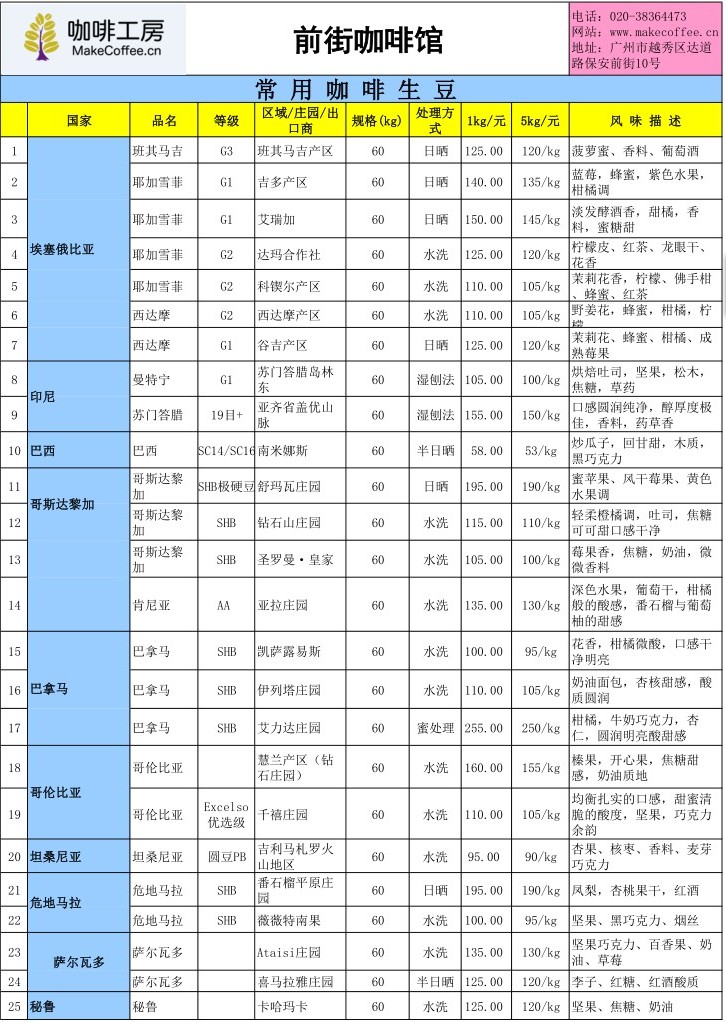
January 14 Yunnan local fresh beans 14.561 yuan kg, international coffee futures 114.95 cents (pounds)
8 Indonesia Manning G1 Sumatra Lindong wet planing method 10.5 yuan 9 Sumatra 19 mesh + Aceh province Gaiyou mountain wet planing method 15.5 yuan 10 Brazil SC14/SC16 South Minas half sun 5.8 yuan 11 Costa Rica SHB very hard beans Shumawa Manor 19.5 yuan 12 Costa Rica SHB Diamond Mountain Manor washing 11.5 yuan 13 Costa Rica SHB Saint Roman
2016-01-16 January 14th Yunnan local fresh beans 14.561 yuan international coffee